





Total Cost of Ownership (TCO) Model for Storage [CLONE]

Total Cost of Ownership (TCO) Model for Storage
Performance-based TCO provides a more accurate way to evaluate storage by measuring the cost of getting work done—not just the cost of infrastructure. Traditional models often overlook the impact of performance, time to completion, and system efficiency on total cost.
This page brings together the framework and the tool. The white paper explains the model and why it matters, while the web-based calculator allows you to apply it—enabling you to evaluate real-world scenarios, quantify workload costs, and compare software vs hardware-accelerated approaches.
Performance-Based TCO
The white paper introduces the model, explaining why traditional cost approaches fall short and how performance, time, and efficiency impact total cost, while the calculator puts that model into practice—enabling you to evaluate real-world scenarios, quantify workload costs, and compare software vs hardware-accelerated compression.
Access the calculator and the white paper below:
There are many metrics that may be important when modeling TCO for storage, including total system level performance, endurance, and total capacity. This model specifically looks at the TCO in TCO $ / TBe / rack / month. Large and small data centers alike use this as a reference to compare current vs future deployments that are optimized for the sole purpose of storing durable storage.
SSDs are of course much faster than HDDs, so looking at an application performance driven TCO model will most likely favor SSDs when trying to achieve a specific SLA or number of IOPS. Workload inputs to the TCO model that materially change the output are capacity utilization factor, error encoding factor, multi-workload replication factor, and data reduction technology. New in 2025 to TCO model materials is a Performance-Based TCO white paper which introduces a time-aware approach to the TCO model.
SNIA has provided a TCO Model for Storage White Paper and a TCO Calculator
The tutorial below explains the Model and Calculator and walks through examples: A new case study on TCO featuring cryptocurrency and computational storage is available in the SNIA Educational Library
What Goes Into a TCO Model ?
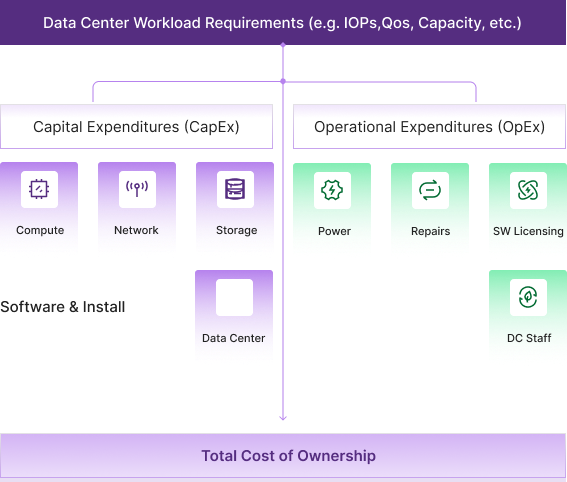
A Performance-Based TCO white paper is now available. This new white paper introduces a time-aware approach TCO model defining TCO for enterprise storage and hyperscale data centers using accelerators. Three case studies illustrate a time-aware approach to TCO examining how to reduce CPU utilization, shorten execution times, and cut energy consumption.
Click on the link below to download the Total Cost of Ownership Model for Storage, which explains what goes into a TCO Model, TCO metrics, modeling the rack configuration, drive input, workload input, and operational expenditures.
Click on the link below to download the TCO for Computational Storage - Compression White Paper. This white paper looks at a case study with Ceph, enabling compression on a single node cluster and comparing it with computational storage. We will use the SNIA Storage TCO model to show the impact of CS on storage costs.
Click on the link below to download an easy to use TCO Calculator based on the TCO White Paper.