






What Is Cloud Storage?

Cloud storage is a way to store data as a service rather than as a device. Instead of thinking about disks, arrays, or file servers, cloud storage lets users and applications store, retrieve, and manage data over a network as if storage were a shared utility. Capacity appears elastic, access is location-independent, and users consume only what they need. From the user’s perspective, where the data physically lives is less important than how it is accessed, protected, and managed.
Why cloud storage matters
Cloud storage shifts the focus from owning and managing infrastructure to consuming storage capabilities through a service contract. In traditional models, organizations plan fixed capacity, provision hardware, and manage lifecycle operations manually. With cloud storage, storage is often provisioned as a service, capacity and performance are policy-driven, and security and management are largely automated.
Cloud storage is a way to store data as a service rather than as a device. Instead of thinking about disks, arrays, or file servers, cloud storage lets users and applications store, retrieve, and manage data over a network as if storage were a shared utility. Capacity appears elastic, access is location-independent, and users consume only what they need. From the user’s perspective, where the data physically lives is less important than how it is accessed, protected, and managed.
Why cloud storage matters
Cloud storage shifts the focus from owning and managing infrastructure to consuming storage capabilities through a service contract. In traditional models, organizations plan fixed capacity, provision hardware, and manage lifecycle operations manually. With cloud storage, storage is often provisioned as a service, capacity and performance are policy-driven, and security and management are largely automated.
What makes storage “cloud”
- Service abstraction: storage is exposed as a service boundary rather than a physical device boundary.
- Elastic capacity and policy-driven provisioning: capacity is allocated dynamically based on service definitions.
- Network-based access: data is accessed over a network through standardized interfaces.
- Multi-tenancy and isolation: multiple tenants or workloads can share infrastructure with logical separation.
- Consumption-based accounting: usage can be measured and metered against service expectations.
What makes storage “cloud”
- Service abstraction: storage is exposed as a service boundary rather than a physical device boundary.
- Elastic capacity and policy-driven provisioning: capacity is allocated dynamically based on service definitions.
- Network-based access: data is accessed over a network through standardized interfaces.
- Multi-tenancy and isolation: multiple tenants or workloads can share infrastructure with logical separation.
- Consumption-based accounting: usage can be measured and metered against service expectations.
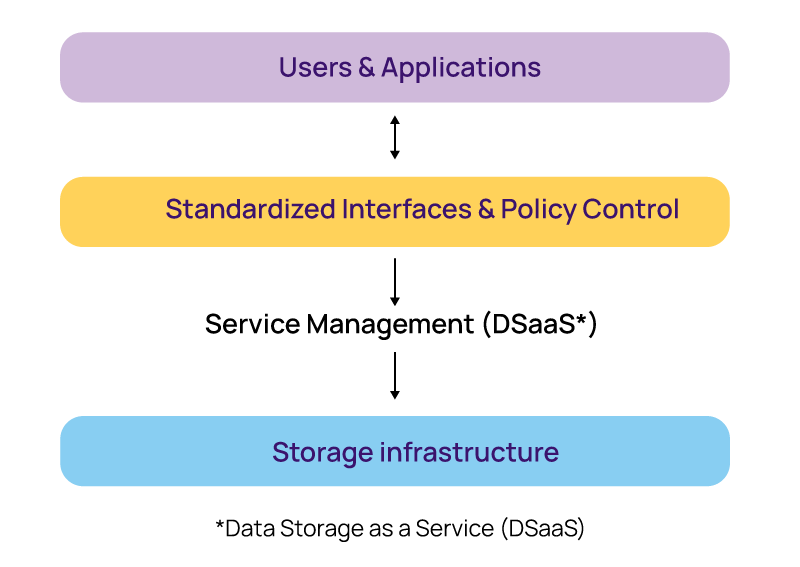
Cloud storage as Data Storage as a Service (DSaaS)
SNIA describes cloud storage as Data Storage as a Service (DSaaS)—storage delivered over a network with defined service levels, abstracted management, and usage-based consumption models. This framing helps separate what cloud storage is (a service model and interface contract) from how it is implemented (specific products, platforms, or media).
Cloud storage as Data Storage as a Service (DSaaS)
SNIA describes cloud storage as Data Storage as a Service (DSaaS)—storage delivered over a network with defined service levels, abstracted management, and usage-based consumption models. This framing helps separate what cloud storage is (a service model and interface contract) from how it is implemented (specific products, platforms, or media).
Deployment models: public, private/on‑prem, hybrid
Cloud storage can be delivered as a public service operated by a provider, deployed as a private/on‑prem cloud platform inside an enterprise, or used in hybrid and multicloud architectures. In all cases, what makes it “cloud storage” is the service model and interface contract—not geography.
Deployment models: public, private/on‑prem, hybrid
Cloud storage can be delivered as a public service operated by a provider, deployed as a private/on‑prem cloud platform inside an enterprise, or used in hybrid and multicloud architectures. In all cases, what makes it “cloud storage” is the service model and interface contract—not geography.
Example: applying cloud storage in modern architectures
A cloud architect might use object or file storage delivered as a service to support analytics, backup, or application data in a way that scales with demand. Policies (for example, retention or immutability) can be applied through metadata and service definitions, enabling consistent governance while teams self‑provision capacity for new workloads.
Example: applying cloud storage in modern architectures
A cloud architect might use object or file storage delivered as a service to support analytics, backup, or application data in a way that scales with demand. Policies (for example, retention or immutability) can be applied through metadata and service definitions, enabling consistent governance while teams self‑provision capacity for new workloads.
Interfaces, metadata, and policy control
Cloud storage is not defined solely by where data resides, but by how data and metadata are managed together. The SNIA Cloud Data Management Interface (CDMI™) emphasizes that metadata governs policies such as security, retention, and capabilities, and that clients can discover storage capabilities programmatically through a standardized management plane.
Interfaces, metadata, and policy control
Cloud storage is not defined solely by where data resides, but by how data and metadata are managed together. The SNIA Cloud Data Management Interface (CDMI™) emphasizes that metadata governs policies such as security, retention, and capabilities, and that clients can discover storage capabilities programmatically through a standardized management plane.
Key takeaways
- Cloud storage delivers storage capabilities as a service with standardized interfaces.
- It is defined by abstraction, elasticity, and policy-driven management—not by a specific location or device.
- SNIA’s DSaaS and CDMI perspectives highlight portability, interoperability, and programmatic control.
Key takeaways
- Cloud storage delivers storage capabilities as a service with standardized interfaces.
- It is defined by abstraction, elasticity, and policy-driven management—not by a specific location or device.
- SNIA’s DSaaS and CDMI perspectives highlight portability, interoperability, and programmatic control.
Learning References
Applicable Standards
SNIA in Action
SNIA Cloud Data Management Interface (CDMI)
Learning References | Applicable Standards | SNIA in Action |
|---|---|---|
SNIA Cloud Data Management Interface (CDMI)
|